The three quarries are each situated just a stone’s throw from rural communities. When we visited this year, we found residents and workers living with daily blasts, dust, and a pattern of neglect that puts their health and safety at risk.
By Justice Nwafor, Christine Ro, Cemre Demircioğlu, Craig Shaw
Dorathy Ushiya was sitting on the veranda of her one-room apartment in Dutse Bmuko, a small community outside the capital, Abuja, in central Nigeria. It was noon on 24 September 2024. Beside her were the homemade bottles of kunun aya, a local drink made from tiger nut, which she sells to passersby. As she chatted with her neighbour, she kept one eye on the road for potential customers; even a few sales could make the difference between feeding her 2-year-old daughter that day.
Then came the explosion. Sudden and violent, like a bomb. Stones and debris shot all around her, hitting her in the face and eyes. She collapsed to the ground. Blinded and in pain, Ushiya was rushed by her neighbour to the clinic, but her injuries were too severe to be treated there, and she had to be referred to a specialist. For the next week, she had to return for daily medication. She was unable to work. Her eyes stayed red and sore for months afterwards.
“I nearly lost my eyes,” Ushiya told us.
The enormous blast not only harmed her physically. The stone and rubble had rained down on her house, damaging her roof and those of her neighbours. “That day, several people ran for their lives and others lay flat on the road as the stones flew around,” Ushiya said.
The blast had come from a nearby granite quarry, barely a few hundred metres from the village, run by a company called Istanbul Concrete. After Ushiya complained to the company, it agreed to cover her medical bills and pay 20,000 naira in compensation – a little over €11. The sum didn’t even cover the income she lost or the cost of the house repairs.
This dangerous blast was not an isolated incident. Multiple residents in Dutse Bmuko told us that, in 2023, a 50-kilogram chunk of rock from one blast smashed through the house of a pregnant woman and landed directly on her bed. Fortunately, she was not resting at the time.
Nor is Dutse Bmuko the only settlement caught in the shadow of stone quarries. A few miles northwest of Abuja, in Kubwa, lies another granite quarry, with a third one located 250 km north, in Zagina, an hour outside Kaduna city. These two mines are owned by Zeberced Limited. The Dutse Bmuko quarry is seemingly owned by Chief Cornerstone Investments but run by Istanbul Concrete.
The three quarries are each situated just a stone’s throw from rural communities. When we visited this year, we found residents and workers living with daily blasts, dust, and a pattern of neglect that puts their health and safety at risk.
Both companies are owned by one Turkish family – the Kurts. They entered the Nigerian market nearly two decades ago and have since expanded into construction, furniture and industrial parks. They have been supported and praised by successive Nigerian administrations and even Britain’s Conservative government. The Kurt family’s successes may also have been aided by connections to the Gülen movement, which for years had a strong presence in Nigeria, especially in Abuja.
The daily reality for affected communities could not be further from the wealth enjoyed by these international companies. While the quarries generate revenues of tens of millions of dollars a year, which yield millions in profit for their owners, nearby settlements have become inhabited blast zones plagued by debris, dust, and relentless noise, making life there almost unlivable.
Life In The Quarries
Dutse Bmuko is a small community of mostly poor residents. Less than five years ago, they had no grid connection and lived mainly in darkness. Even today, the road connecting the town to the wider Dutse area is unpaved and lacks drainage. There is no public water supply system. Residents resort to personal boreholes and rainwater.
But Istanbul Concrete’s operations have since rendered any collected rainwater undrinkable. Dust from the blasts and machinery blankets everything in a thick film. The unpaved road is crumbling. Dozens of heavy-duty trucks pound it daily, hauling crushed stone – the same material that could repair the roads – from the quarry to the buyers. The trucks regularly block the roads, preventing residents from accessing schools and the local market. In 2018, a Zeberced truck driver killed a deaconess on the road from Abuja and was charged with “reckless driving and manslaughter” two years after skipping bail.
Those who live close to the quarry never forget to grab a mask as they leave for work in the morning, said resident Juliet Ugwu. Juliet also knows better than to wear white clothes because the intense dust will stain them immediately. Everyone lives with blasts that can come at any time of the day or night.
Ushiya’s neighbour, Audu Sulaiman, said that the company doesn’t always warn them before carrying out detonations, even though the law requires 48 hours’ notice. This constant unpredictability has put the town on edge.
Sulaiman cannot count the number of times he has been jolted from his bed by midnight explosions. The sleepless nights turn to anxiety-filled days as he worries constantly about the harm the dust is doing to his family’s health. His children suffer from breathing issues, blocked and runny noses, and coughing fits. On hot days, they must weigh the consequences of opening windows for some air. If it is especially windy, they must wear masks to sit outside their home. “When you decide to sit and eat on the veranda of the house, the dust will not let you,” Sulaiman said.
In Kubwa, a semi-urban settlement near Abuja, Zeberced operates what is reportedly the largest quarry in West Africa. Vast and still expanding, it has carved more than three million square metres out of the nearby hill range. Blasts shake the ground, machines whine and whirl mercilessly. With each detonation, a volley of stones flies through the air, striking the homes along the quarry’s edge.
Zeberced’s second quarry is in Farakwai, near Kaduna, 250 km to the north. Here we find a similar story. Farakwai would be a sleepy town if not for the constant din of Zeberced’s stone-laden trucks, which roar down the unpaved road that links the quarry to the nearby villages of Zagina and Tudun-Kaya. The company engages in relentless rock blasting and stone milling with heavy machinery, which also serves two on-site asphalt plants. Dust billows from the trucks, drifting into houses – many built of mud and already cracked – and over a children’s playground a few hundred metres away. When the blasts come, the children scramble indoors.
Entering Nigeria
Zeberced Limited was established by Adil Aydın Kurt and Cemal Kurt in 2007. Fifty-five-year-old Adil is the public face of the Zeberced, a Turkish citizen with ties to the UK and a second passport from the Caribbean tax haven Antigua and Barbuda.
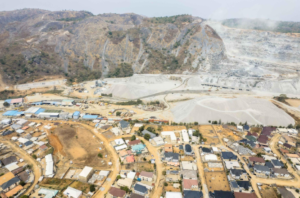
A closer drone shot of Kubwa. Credit Solomon Shaibu.
In a 2023 interview, Adil Aydın Kurt presents himself as a self-made businessman who, at the onset of the global economic crisis in 2007, began searching for a new country in which to do business. He considered Kazakhstan and Uzbekistan, but found that these places “were already occupied.”
He likes to tell a story that when he arrived in Abuja, he found the city “developing and well organised” and Zeberced’s origins as a small rock-crushing company operating out of a “container placed under a mango tree, which has now grown to become one of the biggest quarries in West Africa.”
Little is known about the family’s business past outside of Nigeria or the source of wealth that would justify an international expansion. But in 2011, the company’s fortunes began to change. While accompanying a Nigerian delegation of President Goodluck Jonathan to Turkey that year, Kurt boasted of how he chaperoned the officials to some of the country’s industrial zones. “We said if we get the chance, we would do this kind of [industrial] project in Nigeria,” he said.
Upon his return, Kurt secured 250 hectares of land for what became the Abuja Industrial Park, a flagship $144 million project that has enjoyed the backing of senior Nigerian officials. “Really, after that [trip], they took action and they gave us 250 hectares of land around Idu.”
In 2011, they were also contracted to build the new Turkish embassy in Abuja.
At this time, Turkey was eager to expand its influence in sub-Saharan Africa. One of the most prominent Turkish networks in Abuja at the time was the Gülen movement, a once-powerful Islamic cult built around the teachings of exiled cleric Fethullah Gülen, at one time a close ally of President Erdoğan.
Known as Hizmet or cemaat, the movement’s Nigerian presence began in Abuja in the late 1990s with the establishment of the Nigerian Turkish International Colleges. Their influence spread quickly. The movement opened schools and dormitories, built health centres, and founded trade associations such as the Association of Businessmen and Investors of Nigeria and Turkey. It offered scholarships to bright students, who were expected, in turn, to repay with loyalty and economic support. It also built wells across the country to help locals access fresh water, which is now utilised to celebrate Fethullah Gülen and raise money. (Fethullah Gülen, exiled in Pennsylvania since the 1990s, died last year.)
Firmly entrenched in Abuja life, the movement’s presence became a valuable tool of Turkish soft power when the country sought to enhance trade and diplomacy after 2010. In the years since, Nigeria has become Turkey’s second-largest trading partner in sub-Saharan Africa.
A section of the Gülen movement was later accused of orchestrating Turkey’s failed coup in 2016. In the wake of the attempted putsch, the Turkish state designated the group the “Fethullahist Terrorist Organisation,” dismantled its structures at home and targeted its schools, businesses, and members abroad. In Nigeria, the schools were renamed (Nigerian Turkish International Colleges became Nigerian Tulip International Colleges), but the group nevertheless retains its presence in the country. The Nigerian government resisted recent calls from Ankara to call Nigeria’s Gülenists terrorists and shut them down.
There are no concrete or admitted ties between the Kurt family and the Gülen movement, but there are signs of proximity and sympathies. One of Zeberced’s UK directors, Özlem Kurt, Adil’s wife, was for years an outspoken supporter of the movement on Twitter and a critic of Erdoğan. Their daughter attended a Gülen school in Abuja.
The Kurts have successfully maintained a strong presence in Nigeria throughout this tumultuous era. Adil now speaks of Zeberced as a business “conglomerate,” spanning construction, furniture, and other enterprises, including Istanbul Concrete. In 2018 and 2021, the family set up companies in the UK, which they describe on their website as “proudly symbolising the British presence in Nigeria through its ownership by the British capital firms, Emet International LTD and Myria Global LTD.”
Zeberced’s website describes the holding companies, Emet International (of Zeberced and Zeberced Construction) and Myria Global (of Abuja Industrial Park and Imperium Sustainable Energy Solutions) as established “due to excelerating of the activities in Nigeria and other parts of Africa with the support of UK Government, especially in Commonwealth Countries.” [sic]
The family had earlier launched a firm called Kurt Brothers Limited, though its activities remain unclear. Other family members, such as Zafer, Ercan, and Cansu Kurt, hold various positions in companies in the UK and Nigeria.
Another Turkish family is closely entwined with Zeberced’s operations: the Gündoğdus. Brothers Yusuf Gündoğdu, who studied at Gülen Fatih University, and Yakup, a Turkish lawyer, are directors of the group’s furniture companies, Zeb Decor and Zeberced Furniture. Yakup is also director of Istanbul Concrete with the Kurts. The Kurts, however, do not publicise the family’s ownership of the company or the work they do running the Dutse Bmuko quarry.
Yakup recently married Meram Indimi, daughter of Nigerian oil billionaire Mohammed Indimi, which highlights the family’s deepening ties with Nigeria’s political and business elite.
Adil Kurt insists the companies have never relied on state contracts, though they now enjoy high-level political support from Nigerian officials and the UK. Last year, Kurt met with Kashim Shettima, Vice President of Nigeria, who “commended [Zeberced] for their contributions in infrastructure and job creation” and touted plans to create “40,000 direct jobs” through the Abuja Industrial Park. (Adil Aydin Kurt has left a Google review for his own park, calling it a “fantastic project.”)
In the comments on the Facebook post, however, some Nigerians complained about the negative impact of Zeberced’s quarries, citing damaged roads, dust particles, and suffering residents. “In all sincerity the company needs to be sanctioned,” said one.
“The way the blasting is done is horrible,” said another. “The government should please come to our aid.”
In 2024, the UK business and trade secretary, now the leader of its Conservative Party, Kemi Badenoch, appeared at the groundbreaking ceremony for Zeberced’s Abuja Industrial Park. This marked the signing of an Enhanced Trade and Investment Partnership agreement between Nigeria and the UK. The Abuja Industrial Park cost $144 million, though the exact origins of the financing are not known. The UK’s Department for Business and Trade states that it “has not engaged in conversations pertaining to investment in Abuja Industrial Park.”
The finances behind Zeberced are not public. The companies refused to provide them. Last year, however, the Abuja Community studied both Zeberced’s and Istanbul Concrete’s operations, calculating how much each extracts daily. The publication determined that between them, the companies generate 12,000 and 20,000 tonnes of granite per day, resulting in revenues of ₦72 million ($47,000) and ₦120 million (US$78,000).
In 2023, Zeberced paid ₦3.89 billion (approximately $6.6 million based on the average exchange rate for 2023) in taxes, licences, and royalties, according to the Extractive Industries Transparency Initiative. If these numbers are accurate, the three mines generated revenue of tens of millions of euros and millions in profit. These calculations seem unrealistically high, they give some idea of the wealth being extracted by foreign-owned companies at the expense of neighbouring communities.
Broken Rules And Promises
The National Environmental (Quarrying and Blasting Operations) Regulations Act 2013 forbids blasting or quarrying within three kilometres of residential or commercial areas. Zeberced claims, “At the time of the approved Environmental Impact Assessment (EIA) and commencement of operations, there were no residential structures located within 3 kilometres of the outer boundary of the site.” Drone footage reveals that both Zeberced’s Kubwa quarry and Istanbul’s Dutse Bmuko quarry are situated directly adjacent to homes. This is further supported by Google Earth satellite images, which show that they were already present before operations began.
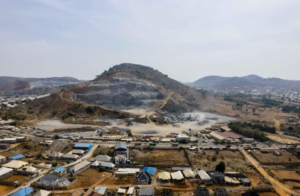
Drone photo of Dutse Bmuko. Credit Solomon Shaibu.
Some residents moved to the area after the companies started operating there. Many were already there. Chief Hassan Shakpara’s family has lived in Dutse Bmuko for generations. He says that there were houses in the area before Istanbul Concrete’s quarry started operating in 2011, and it has only become more built up in the decade since.
A former blast intern at Zeberced’s Kubwa quarry confirms that the company carries out detonations up to six days a week, depending on the availability of explosives. This weakens the foundations of the houses. He estimates that some properties are around 1.5 km from the blasting area. There’s a major market close by.
Festus Ogun, a human rights lawyer and partner at FOLEGAL, said the blame is also on regulators like the National Environmental Standards and Regulations Enforcement Agency and the Ministry of Environment for failing in their duties. “The agencies of government that are responsible for enforcement of (environmental regulations) seem not to really carry out their statutory obligations,” Ogun said, adding that violations should lead to “suspension or revocation of licenses.” He explained that owners and directors of the companies “should be prosecuted because there are criminal angles to these violations.”
Getting the go-ahead for the quarry required a ‘Community Development Agreement’ with local leaders. The Dutse Bmuko agreement, signed by Chief Cornerstone Investments, committed the company to several key initiatives, including building three classrooms, providing 40 tonnes of granite each month for a decade, 40% employment opportunities for local young people, and an ambulance for the community, among other things, like cash payments.
Chief Hassan, one of the two chiefs in Dutse Bmuko, says that Istanbul Concrete did construct a primary school, but “they have not done anything else.” Nor has the community benefited from permanent jobs, according to Chief Hassan. Some local residents gain work as cleaners or night security only on a casual basis. “The company does not want to employ our people,” Chief Hassan said, even though many of the residents are qualified to operate heavy machines.
Dutse Bmuko’s community agreement specifies that the company “shall reasonably take precautionary measure while blasting as shall ensure safety of lives and properties of the host community including the sounding of alarm sires shall constitute warnings and notices in order for the people to evacuate.” [sic]
In Kubwa, Zeberced operates under a community development agreement with similar stipulations on blasting, though this is currently being renewed, according to the Ministry of Solid Minerals Development.
Zeberced insists it only blasts on Mondays, with “advance notifications through signage, community notices, liaison officers, and the use of sirens.” Yet during our visit in April, we witnessed an unannounced mid-week blast. The huge explosion shook buildings. Throughout our visit, there was constant noise and vibrations. The residents here feel particularly aggrieved about the persistent presence of Zeberced traffic on the road between the quarry and the community, which is plagued by blockages, dust, and damage.
In Farakwai, the two villages most severely affected are Tudun-Kaya and Zagina. Dust from the movement of heavy-duty trucks billows into Tudun-Kaya, making farming and daily life nearly impossible. Curiously, Zeberced signed its community agreement with Zagina only, not Tudun-Kaya, a move one resident described as “divide and rule.” Zeberced told us that the village “is represented through the Zagina community in this agreement.”
The agreement commits the company to provide employment opportunities, a school, a mosque and scholarships. Some buildings were constructed, albeit in a disorganised way over several years. Locals also complained that the promised jobs for residents never materalised. Among the community’s grievances are the boreholes, which were drilled but quickly abandoned.
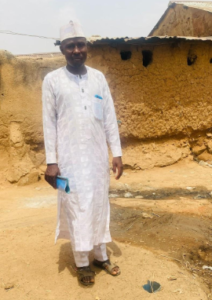
Alhaji Yinusa Yusha’u, a member of the Zagina community development committee, stands close to an abandoned borehole site. Credit Justice Nwafor.
A Heavy Toll On The People And The Land
In Tudun-Kaya, residents say that the health effects have been severe and, in some cases, fatal. Farmer Ahmed Abubakar lost his wife, who suffered from chronic asthma, five years ago, which he says was exacerbated by the poor air quality. His two 11-year-old sons have begun to show the same symptoms. He fears the worst. They receive medical care twice a month, but his meagre earnings don’t allow for more. The air aggravates their condition.
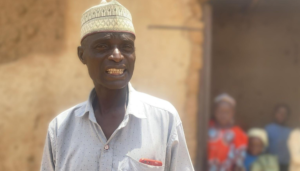
Ahmed Abubarkar and his family. Credit Justice Nwafor.
Miles away in Dutse Bmuko, Juliet Ugwu said her health began to deteriorate soon after she moved there, a little over a year ago. “All of a sudden, I noticed I was having difficulties breathing,” she said. Dust would frequently enter her eyes as well. These are aspects of life her neighbours, who have lived in the area longer, take for granted. At one point, she had to move in with a friend for three weeks to have a respite. Juliet plans to leave as soon as her rent agreement expires. “I don’t really think the people here are living that good, healthy life they ought to live.”
Dr Golibe Ugochukwu, a public health physician based in Nigeria’s southeast, said the experiences of families around the mines are not uncommon; prolonged exposure to dust and air pollution diminishes the quality of life and mental health of residents, he said. “People who live near these mines are [at risk of] coming down with atopy, which is a hypersensitivity reaction to dust, asthma, and other respiratory infections, such as chronic obstructive pulmonary disease.”
Beyond these diseases, prolonged exposure weakens the immune system and “predisposes residents to tuberculosis,” Dr Ugochukwu added. For the people who live and work in close proximity to mines, the frequent loud noises and the near-constant rattle of transport vehicles bring further dangers.
Noise pollution in the communities affects residents in two ways, said Dr Ugochukwu. First, the continuous exposure to high-decibel noise can reset the hearing levels of residents. “Because they are hard of hearing, they would gradually inch towards becoming deaf.” The constant blasts can be even more devastating for those closest to the mines. The noise can damage their eardrums and cause permanent hearing loss.
As for environmental compliance, there has been a lack of transparency. The National Environmental Standards and Regulations Enforcement Agency did not supply the environmental impact assessments for the mining projects in Dutse Bmuko and Kubwa, despite requests under the Freedom of Information Act. Zeberced claims that the environmental impact assessments for the Abuja Industrial Park and “all other projects and associated activities” are comprehensive, regularly monitored, and publicly accessible.
An independent study of the environmental impacts in Kubwa found that some houses were located less than 50 metres from Zeberced’s quarry. Noise pollution was significantly higher than the permitted level for residential areas. Nearly seven in ten residents surveyed pointed to cracks in their homes as the most damaging effect of the blasting.
In early 2024, TheCable measured air quality in the community. Between January and March, PM10 levels averaged 45.8 micrograms per cubic metre, already above the World Health Organisation’s limit of 45. Far worse were the PM2.5 results, with an average of 39.2, more than twice the WHO safe limit of 15.
Both PM2.5 and PM10 are harmful to human health. The California Air Resources Board explained that exposures can lead to respiratory diseases, including asthma, reduced lung function growth in children, heart attacks and strokes, and even lung cancer.
Zeberced stated of the reports of chronic asthma and deaths due to intense exposure to dust, “We are aware of the reports cited [in TheCable] and take them seriously. We operate within the permissible dust exposure limits as prescribed by applicable law and international standards and proactively employ dust suppression methods, including constant watering of internal roads, pre-blast wetting, and other technology. We are open to third-party review and constructive dialogue with affected communities.”
Zeberced “Doesn’t Care About Safety.”
Everyone from Zeberced to the Nigerian government has made a big deal about how the quarries would create employment opportunities for residents. Instead of solely recruiting locally, however, the mines hire workers from other parts of Nigeria or from Turkey, locals said.
One former blast intern told us that there is also segregation within the company, between the management and administrative staff who are mostly Turkish and the Nigerian manual labourers. Some Turks are friendly and speak basic English. Most don’t.
This segregated culture affects how the workers are treated. The Turkish staff shout at the Nigerians. “It’s like habitual for them…and most of them don’t understand English,” he said. This can cause difficulties in understanding instructions, which, in a loud and hazardous workplace with explosives and machinery, can lead to confusion, a machine operator at the Istanbul Concrete told us. “They just speak,” the operator said. “Whether you hear or understand… does not concern them”.
The operator said he works 10 hours a day, six days a week, for minimum wage and occasional bonuses. The company often fails to provide masks, goggles, or safety boots, meaning he must pay for these items himself. But even these aren’t always enough to combat the hazards they face. “When we are working, the stench of the chemicals affects us.” His employers, he said, “don’t care about safety.” Some staff members wear flip-flops on site and handle explosives with their bare hands.
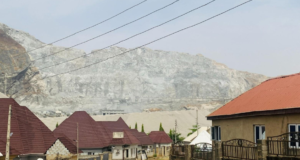
Houses close to the Kubwa quarry. Credit Solomon Shaibu.
“To be very honest, I don’t think I would like to work for them [again],” the ex-intern said. “If it were a Nigerian who was heading the company for them in Nigeria, it would have been better. But this was headed by the Turkish, and the Turkish do not really give a damn about us.”
The justification for providing licenses and support to companies like Zeberced is the creation of jobs. Indeed, the company told us that only 50 of its 2000-person workforce is foreign. It did not break down the proportion of the 50 foreign workers in senior positions versus lower-paid manual roles.
The glowing, uncritical coverage of the Abuja Industrial Park has consistently highlighted the creation of 40,000 jobs – a claim repeated by officials and politicians alike. By the company’s own admission, however, the park has so far created fewer than a thousand jobs. Zeberced said, “471 direct jobs and approximately 500 contractor position[s] have been created to date at the Abuja Industrial Park. We expect this number to grow significantly as additional tenants commence operations.”
Seeking Redress
Residents have complained about the destructive mining activities, even going so far as to stage protests. But this has had little effect. One Kubwa resident told us police broke up a demonstration with teargas in 2021. In Kaduna, authorities warned community leaders not to speak out against Zeberced.
It makes little difference to pursue legal avenues. Kubwa residents have brought several petitions against Zeberced. In 2019, one of these led to an injunction by the Federal Capital Territory High Court to temporarily suspend Zeberced’s activities. The company continued its operations regardless. Zeberced says that it is not aware of any court injunctions against it.
Residents have little hope that the situation will improve. Alhaji Salisu Umar, in Kubwa, regularly finds fresh cracks in the walls of his home due to the blasting. “Redress is for God,” he said. He has little faith in Nigeria’s leaders. Others keep quiet out of fear of the company’s connections and power.
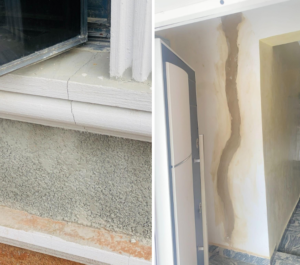
Cracked walls in Alhaji Salisu Umar, Kubwa. Credit Justice Nwafor.
Zeberced has cultivated a very different image from the ones presented by residents and some workers. Since the Kurt family established it in 2007, they have presented themselves as a nation-builder, constructing roads, schools, and clinics, and spearheading the $144 million Abuja Industrial Park. Ministers and even the vice president have publicly praised the company, which has looked to cultivate friendly relationships with Nigerian media. But many of its promised community projects never materialised, or were left half-built, and its operations might finally be under parliamentary scrutiny.
In March, Nigeria’s parliament broke from the praise of Zeberced to raise concerns over the company’s “negative impact” on the communities beside the Kubwa quarry. Lawmakers accused Zeberced of violating the Minerals and Mining Act and the Environmental Impact Assessment Act, citing widespread complaints of health impacts, cracked houses, and “psychological distress” from blasting and transport. They recommended an investigation that could revoke its licences to operate. Parliament has also questioned the cost and design of Zeberced’s other projects, including the Pai and Yangoji–Sukuku roads, demanding evidence of proper engineering and costing.
Nearly six months later, there has yet to be a public declaration from the parliament on whether a formal and active investigation is underway.
Istanbul Concrete did not respond to our questions.
Edited by Himanshi Ojha
Photographs by Justice Nwafor
Drone Footage and stills by Solomon Shaibu
Produced with the support of JournalismFund Europe.