The webinar concluded with a call for comprehensive legal reforms to close existing loopholes and strengthen accountability mechanisms.
By Our Reporter
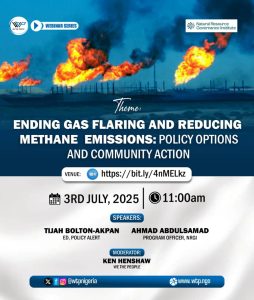
On July 3, 2025, We the People in collaboration with Natural Resource Governance Institute (NRGI), held a webinar titled “Ending Gas Flaring and Reducing Methane Emissions: Policy Options and Community Action.” The discussion brought together policy analysts, civil society leaders, and community advocates to examine Nigeria’s efforts to curb methane emissions and end routine gas flaring, in line with international climate commitments and local development priorities.
Ahmad Abdulsamad, Programmes Officer at NRGI emphasized the urgency of aligning Nigeria’s emissions reporting and reduction strategies with European Union (EU) standards, noting that the majority of Nigeria’s liquefied natural gas (LNG) exports go to EU countries.
He informed that failure to meet the EU’s stringent climate policies, particularly around methane emissions, would expose Nigeria to steep carbon tariffs and non-tariff barriers that could significantly affect its energy trade.
According to Ahmad, a critical issue is that emissions data in Nigeria are largely self-reported by operators, which contradicts the EU’s demand for independent verification and transparency. He cautioned that such inconsistencies not only undermine Nigeria’s credibility but also put the country at risk of being shut out of key markets.
Ahmad further referenced Nigeria’s commitment to the Global Methane Pledge, which calls for at least a 30% reduction in methane emissions by 2030. While some domestic measures such as penalties issued by the Nigerian Upstream Petroleum Regulatory Commission (NUPRC) and Nigeria’s Nationally Determined Contributions (NDCs) signal progress, he stressed that these efforts must be translated into enforceable laws.
Domesticating the Global Methane Pledge, he argued, would ensure better compliance and enable regulators to hold operators accountable.
Ahmad also criticized the federal government’s approach of making ambitious declarations without revealing clear methods for implementation. He highlighted a paradox in Nigeria’s strategy where efforts to reduce methane emissions are being undermined by simultaneous plans to increase gas output.
In his presentation, Tijah Bolton, Executive Director of Policy Alert, focused on the legal frameworks governing Nigeria’s oil and gas sector and their limitations in curbing methane emissions. He highlighted the inconsistency in government messaging, stating that although gas flaring is widely declared illegal, the Petroleum Industry Act (PIA) still allows it with ministerial approval. This legal loophole, he noted, gives oil companies the flexibility to continue gas flaring indefinitely.
Tijah called attention to the NEITI Act of 2007, which empowers citizens and the Nigeria Extractive Industries Transparency Initiative (NEITI) to demand operational and financial disclosures from companies in the sector. He stressed that civil society organizations, the media, and the legislature have a vital role in pushing for methane emission reporting that meets global standards.
Tijah also raised concerns over the ongoing divestment by international oil companies (IOCs), which he described as a deliberate attempt to transfer environmental responsibility and legacy pollution onto local companies. He criticized IOCs for creating heavy carbon footprints and now leaving the cleanup to others, all while publicly claiming improved environmental performance.
Using the Freedom of Information (FOI) Act, Tijah urged Nigerians to hold both government agencies and publicly funded entities like the Nigerian National Petroleum Corporation (NNPC) Limited accountable for their environmental practices. He concluded with a strong call for harsher penalties for companies that fail to invest in methane mitigation technologies and infrastructure.
Participants at the webinar echoed the need for stronger action, raising concerns about poor data collection and the challenges of validating methane emissions figures. They also emphasized the importance of local communities and media in holding government and companies accountable. Several participants underscored the health implications of methane exposure, calling for a shift from technical statistics to human-centered storytelling to better communicate the urgency of the issue.
The webinar concluded with a call for comprehensive legal reforms to close existing loopholes and strengthen accountability mechanisms. Participants recommended the enforcement of stricter penalties for non-compliance, including the suspension of licenses for defaulting companies. The session ended with a renewed commitment to advancing public advocacy and continuing dialogue on ending gas flaring and reducing methane emissions in Nigeria.